Privacy fence
Privacy fence installation.
6' and 8' privacy fence in wood, vinyl, or composite. Built so you actually can't see through it once the boards dry out.
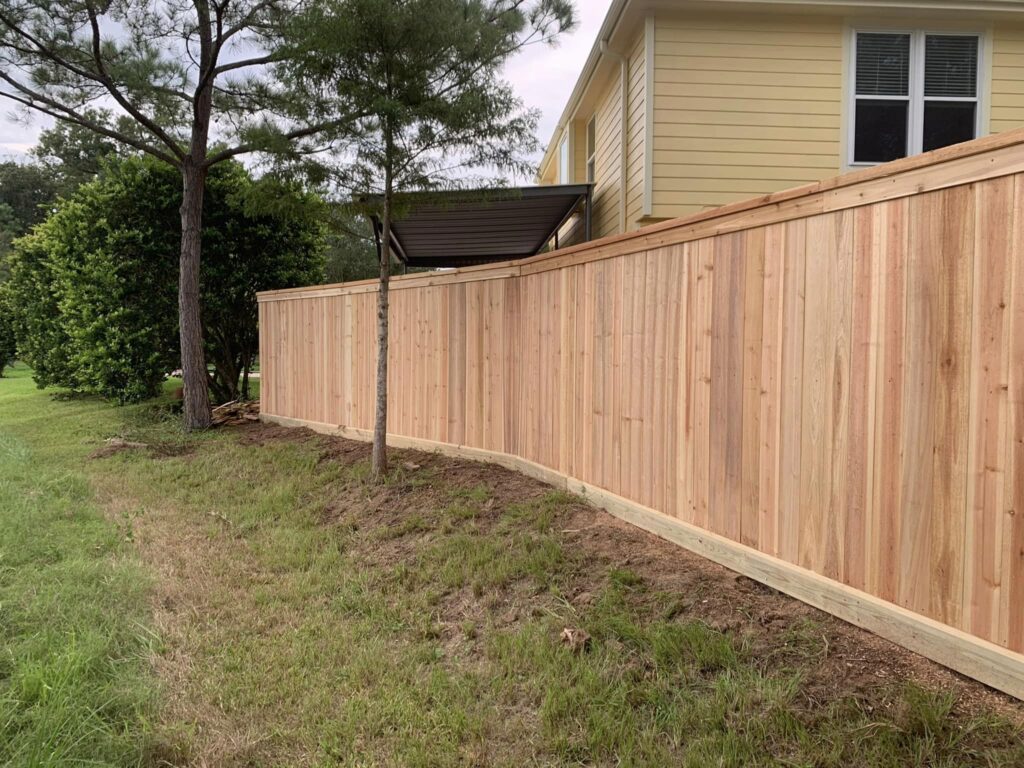
Why ours stays private
Privacy fence built so it stays private.
The main complaint we hear about privacy fences from other companies: after a season, you can see straight through the gaps. That's what happens when panels are built board-to-board with no overlap and then the wood dries out and shrinks. A quarter-inch of shrinkage per picket adds up fast when they're only sitting shoulder-to-shoulder to begin with.
We default to board-on-board or shadowbox for exactly this reason. Board-on-board overlaps every picket by a full inch, so even if the wood shrinks the maximum you'd ever expect, there's still no line of sight. Shadowbox gets you the same result while looking identical from both sides of the fence — which matters if your neighbor is splitting the bill.
We also spec the posts one size up on anything 8 feet tall. A privacy fence is a wind sail, and the load on an 8-footer is close to double what a 6-footer sees. Standard 4x4 posts in a shallow hole aren't going to hold that up in a WNC storm.
Materials
Privacy fencing materials, and when to pick which.
Pressure-treated wood is the default — cheapest per foot, easy to repair, easy to stain the color you want. If you're on a long run and cost matters, wood wins on day one. The trade-off is that you'll want to seal or stain it every three to five years to keep it from graying out.
Vinyl privacy costs 30–50% more up front and effectively zero after that. No stain, no rot, no replacing a warped picket in year seven. We only install heavy-wall vinyl with aluminum-reinforced gate posts, because the box-store thin stuff bows in the heat and sags at the gates within a year.
Composite is the premium option — wood-grain texture, no maintenance, and it doesn't fade the way vinyl can in direct sun. It's the most expensive of the three, but on a house where the fence is a design feature and not just a boundary, it's usually the right call.
Common questions
Planning a tall privacy fence in WNC.
Two things trip up most privacy fence projects around here: setback rules and slope. A lot of the towns we work in cap fence heights in a front yard at 4 feet, and require an 8-foot fence to sit off the property line by a specific distance. We pull those numbers before we quote so you're not fighting the town after the fact.
On slopes we rack the panels — meaning the top and bottom rails stay parallel to the ground, but the pickets remain vertical. Stepping a privacy fence down a slope leaves triangular gaps that defeat the whole point. Racked panels follow the grade cleanly and keep the privacy line unbroken.
If you're ready to walk a line and talk numbers, reach out for an estimate. We usually get out within a week.